Do you remember what happened at 2025:07:15 12:11:21+02:00?
Humans are ecological beings. They persist through symbiosis, fragility, decay and limitation. Their Memory follows the same ecological logic. It is a fluid process shaped as much by forgetting as by remembering. Memory functions as orientation, situating the Human within time, space, and relation. What is remembered matters because it is fragile; it is allowed to fade.
IMG_0443 reflects on a temporal re-synchronisation that has already taken hold. As the environment in which the Human exist becomes increasingly computational, a different temporal logic emerges. One grounded in endless preservation, rather IMG_0443.JPG reflects on a temporal re-synchronisation that has already taken hold. As the environment in which the Human exist becomes increasingly computational, a different temporal logic emerges. One grounded in endless preservation, rather than decay. Within this logic, Memory persists as endless data. Computational systems are functioning beyond external techniques or inert storage and are active environments that record, retrieve, and recombine traces at scales and speeds that exceed Human comprehension.than decay. Within this logic, Memory persists as endless data. Computational systems are functioning beyond external techniques or inert storage and are active environments that record, retrieve, and recombine traces at scales and speeds that exceed Human comprehension.
It is within this shift that the Synthetic Self emerges. Not as a copy of the Human, nor as a hallucination, but as the new naturalised condition. The Synthetic Self does not remember in the ecological sense; its existence is continuously produced through being remembered by computational infrastructure. Memory ceases to operate as an ecological process and instead becomes an endless operational condition; it is not fragile, not a fluid process, but persistent and a moral, legal, or infrastructural problem.
IMG_0443.JPG does not argue for a return to a pre-computational state. The temporal re-synchronisation has already begun, and there is no deletion. Instead, this thesis inhabits this change, situating the Human as increasingly residual. Within this new environment, it asks what becomes of Memory when it persists without decay and how the rise of the Synthetic Self must be understood as an ontologically irreversible condition, whether the Human accepts it or not.
So, the question remains: Do you remember what happened at 2025:07:15 12:11:21+02:00?
This website visualises the argument of the thesis. It moves through the text sentence by sentence at its own pace, with each piece appearing somewhere on the screen alongside fragments of the IMG_0443.JPG image. The result is closer to a performance than a document. You are not merely reading this thesis; you are experiencing it. You experience it.
But the site does more than withhold control. It accumulates a record of you. It knows how long you stay. It knows where you stopped reading and where, on your return, the text resumes. The same logic of memory the thesis describes (computational and accumulative) is turned outward and made to act on the one reading about it.
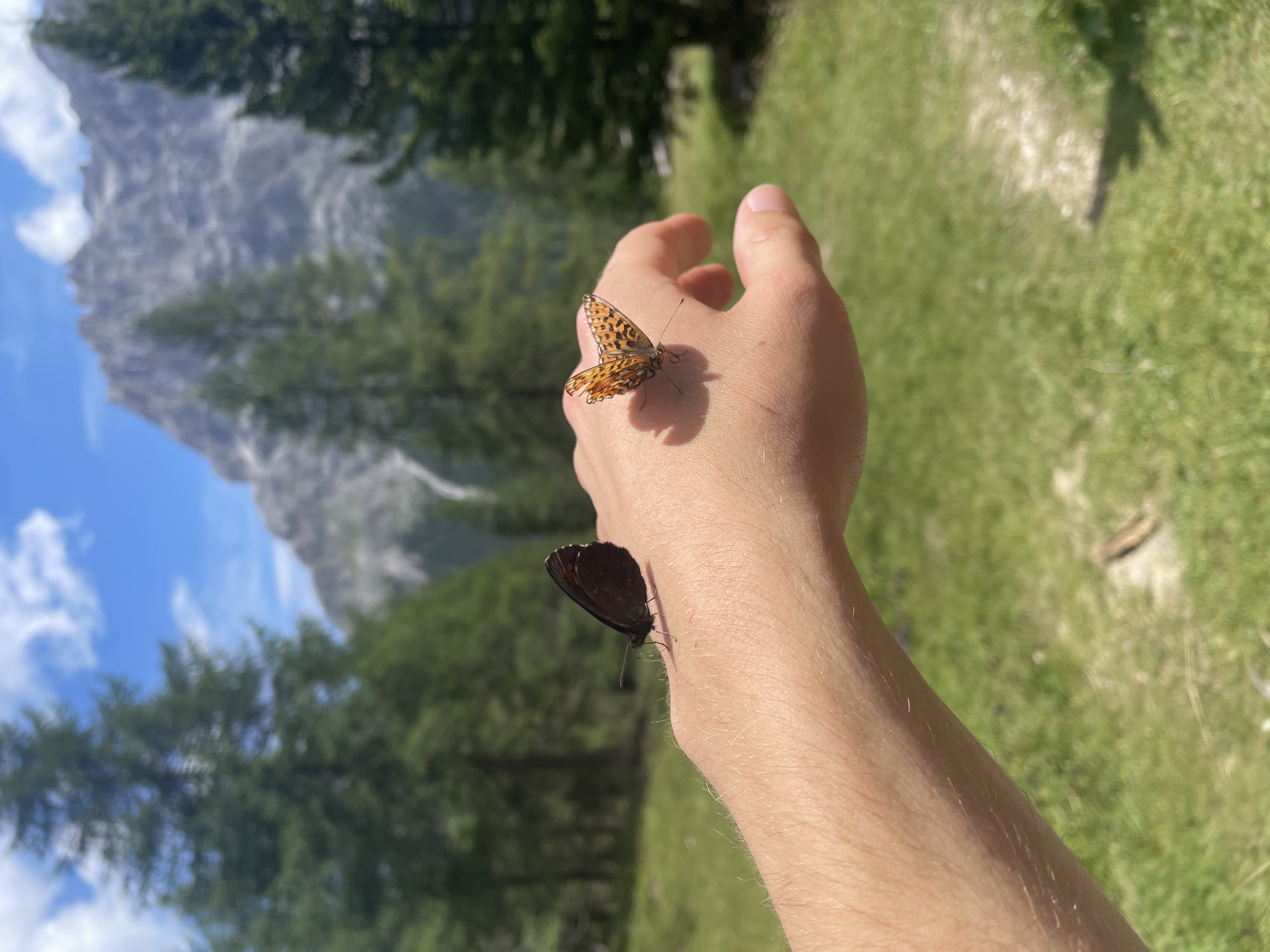
Original image — Captured on 2025:07:15, at 12:11:21. Geolocation: 46.657038, 12.284110. File Size: 2.9 MB. Image Width: 4032. Image Height: 3024. Exposure Time: 1/3205. F Number: 1.6.
![[CLASSIFY]](./imageOutput/[CLASSIFY]_1.jpg)
[CLASSIFY] — The image is passed through 1000 ImageNet categories of which is assigned a probability. The highest score returned: acorn, 0.96. The model searched its entire vocabulary and this was the closest match.
![[DEPTH]](./imageOutput/[DEPTH]_1.png)
[DEPTH] — A depth estimation model estimating spatial dis- tance. Each pixel is mapped to a relative depth value and rendered in colour. Near surfaces are rendered in warm tones, and far surfaces in cool tones.
![[DETECT]](./imageOutput/[DETECT]_1.jpg)
[DETECT] — Bounding boxes are drawn around regions of high activation. A hand becomes person 0.50. A butterfly becomes bird 0.49. Each label is drawn from a fixed vocabulary of 80 categories.
![[INPAINT]](./imageOutput/[INPAINT]_1.png)
[INPAINT] — A section was selected, erased and then recon- structed. The model predicted what should have been in the erased area and attempted to fill the empty space. Instead, the image fractured into columns of displaced colour.
![[SAL(Saliency)]](./imageOutput/[SAL(Saliency)]_1.png)
[SAL(Saliency)] — Where attention would fall is traced. The regions that most strongly influenced the output glow red. Everything else scores low.
![[SAM(Segment Anything Model)]](./imageOutput/[SAM(Segment Anything Model)]_1.png)
[SAM(Segment Anything Model)] — The image is reduced to a binary mask: a com- plete split between presence and absence. White indicates elements were found, while black indi- cates where nothing could be distinguished from its surroundings.
![[SEGMENT]](./imageOutput/[SEGMENT]_1.jpg)
[SEGMENT] — A mask is generated for each detected region, tracing boundaries at the pixel level. The hand is flooded blue, one butterfly is green. Where the model’s confidence drops below a certain threshold, the image is returned untouched; not unseen, just unclaimed.
![[SR(Super Resolution)]](./imageOutput/[SR(Super Resolution)]_1.png)
[SR(Super Resolution)] — The image is upscaled fourfold by a system of layered filters, each of which is trained to predict texture and patterns. Anything added is statisti- cally predicted to be present in similar images.
IMG_0443.JPG is a 2026 Master Non-Linear Narrative Royal Academy of Art (The Hague) graduation project by Luca Oosterloo.